By now, most people have seen January 7th footage of an ICE agent in Minneapolis shooting a woman to death behind the wheel of her car. Already, experienced firearms instructors and law enforcement professionals have broken down the video and exposed what should be obvious to any viewer: an armed masked man deliberately placing themselves in a situation to commit legal murder.
As someone who numerous times stood in similar places to that ICE agent, I have a unique perspective.
Between 2017 and 2020, I worked providing armed protection at numerous political events and marches where fascists often used vehicles to block and intimidate nonviolent protesters engaging in free speech actions. Charlottesville became the most famous example of right wing violence through weaponizing a vehicle but this soon spread nationally. So many chose this tactic, it even fostered legislation in several conservative states protecting drivers using vehicles to run over pedestrians if they felt threatened.
So, I know what it feels like when angry men in trucks yell threats while driving toward a group of people including children. As I’ve written before, they frequently brandish paintball guns or real firearms and in high stress situations, telling the difference can be difficult. However, I never drew my sidearm, worked with a team to deescalate individuals and every situation ended peacefully. Making the right call in such shoot/don’t shoot situations is crucial for anyone working in an armed capacity.
Right wing media outlets naturally claim Minneapolis was a justified shooting and, for a while, repeated Trump’s transparent lie that the officer was run over and seriously injured. Of course, arguments that an ICE agent with far more formal training than myself felt threatened enough by a slowly moving vehicle with its wheels turned sharply away from him to shoot the driver once through the windshield are absurd.
Anyone with eyes can see the officer paused and then casually changed position before firing twice more through the open driver’s side window. Instead of a screaming man threatening violence from inside a lifted pickup, as I have many times found myself confronting, the ICE agent killed a calm woman whose final words in the video are: “That’s fine dude, I’m not mad at you.”
Because the video evidence is so damning, right wing chatter largely relies on playing up the emotional toll that ICE agents allegedly suffer from citizens calling them rude names. They argue that any gray area exists because ICE has been so unfairly treated by the media and protesters that its officers can’t help but slip up occasionally and shoot a few people.
In my personal experience, that’s a laughable justification. Despite being verbally abused by fascists across the Pacific Northwest, having my children’s lives threatened, viewing countless videos of fascists weaponizing their vehicles and finally seeing the highest levels of US government label “antifa” a terrorist group一 I still somehow always refrained from firing into MAGA trucks with mouthy drivers and revved up engines. If antifascist can stay cool and deescalate tough situations, professional ICE operatives have zero excuses.
“My dad says in a few years they’ll outnumber us white folks.”
Another 5th grade boy jerked his head towards the Asian kid walking near our small circle at recess, quickly lowering his voice. The others nodded gravely, pulling closer. I scanned from face to face and a queasy knot twisted my stomach. These other boys were not friends, yet suddenly I’d been included in a special club simply by sharing their same skin color. It was clearly shameful, why else did everyone look so nervous? Even silently participating left me feeling nauseous as the other youths switched topics, laughing awkwardly, then moving on without me.
Seattle, much like the wider Pacific Northwest in the mid 1980s, hardly felt like a place where whiteness was threatened. Only a small handful of Black students attended our large school. Classes were scattered with Asian children and a few Native ones too. White kids formed the vast majority and many retained proud cultural affiliation with European nationalities. Our neighborhood of Ballard was a historic Scandinavian enclave… people joked that it was the last place left where Swedes and Norwegians still hated each other.
Grade school allowed limited political conclusions. We learned European colonists were brave pioneers, simply bringing civilization to new lands. For Thanksgiving, our classes dressed up in construction paper Indian costumes and acted out pageants welcoming white settlers. Yet, as a voracious reader, I knew better… about chattel slavery, civil rights struggles, and Native American genocide. Martin Luther King Day was only first observed nationally in 1986, perhaps not coincidentally the same year my schoolmates felt their whiteness under peril.
Over subsequent decades, progress crawled forward. Despite qualms from conservatives that social equality would destroy America, capitalism grudgingly found diversity acceptable. I remember some leftists predicting that future anti-war movements would contend with inclusive flavored imperialism that showcased transgender pilots bombing hospitals while femme combat soldiers waved rainbow flags.
October 12, 2025: children playing in the smoking ruins of war torn Portland (according to President Trump)
But that didn’t happen. Instead, fascism under Trump Pt. II now features state power unleashed against immigrants and citizens of color, while offering preferential treatment to white asylum seekers. Transgender soldiers forced out of the military with no retirement benefits, even after lengthy years of service. National Parks removing historical markers commemorating resistance against slavery. Federal troops ordered into American cities to combat imagined insurrections while lists of dangerous words are sent out for removal by agencies and nonprofits. One banned in my workplace providing mental health services for youth, including victims of child sex trafficking? EQUITY.
Another banned word: GENDER
In 5th grade I didn’t speak up against racism but adults have no excuses. Excluding others because of who they are is wrong. Erasing uncomfortable history to avoid reality is weakness. Persecuting immigrants of color while welcoming white ones is hypocrisy. Turning the US military against Americans is a crime. Perhaps someday I will live in the minority, but as a white man who doesn’t need government troops propping up my place in the world. No social status is worth the shame of state power forcing others down below me.
With Trump’s recent reelection and the prospect of right wing violence rising once more , it’s that time again when myself (and every other armed leftist) receives more requests for guidance and training than we can handle. So, before jumping in, please take a moment and reflect on whether gun ownership is right for you and your situation. There will be many roles necessary over the coming years as we struggle against fascism and not all require rifles on backs and pistols on hips.
Guns are not amulets
In times of crisis when so many communities and individuals are vulnerable, buying a firearm shouldn’t be merely retail therapy. Because so much right wing posturing revolves around fetishizing gun culture, leftists can easily feel overly giddy anticipating their first purchase. It’s undeniably valuable gaining more equal footing with those who wish us harm, but firearms not consistently practiced with become worse than useless. They are a huge social and personal responsibility. Anyone who can’t commit to or afford regular training and necessary supplies should consider less lethal self defense options like pepper spray or tasers.
Guns don’t create community.
Firearms can form a valuable part of community defense, but with no solid community base, what’s the point? Remember that the main strengths of leftist politics aren’t located in force of arms but popular values. Voters rejected a Democratic party skewing increasingly rightward and who moved moved beyond parody, actually embracing neoconservative specters like Dick Cheny. Progressive social issues remain winning ideals, even in states considered solid Trump territory. Xenophobia, nationalism, misogyny, isolationism, and bigotry still seduce many Americans, yet communities supporting reproductive freedom, promoting anti-racism, police accountability, gay rights, and anti authoritarianism are inspiring in their common decency. These are beliefs no reality TV demagogue can easily sweep aside and remain worth defending.
3. Ethical guns don’t exist*
One of the first questions I’m often asked is: “Can you point me to a liberal FFL dealer?” (Federal Firearms License) Here in Portland The People’s Armory exists, yet most places you’re best off ordering online through whatever nearby shop flies the fewest Confederate flags and hurrying out before some ogre in a Blue Lives Matter shirt sells you a questionable Turkish shotgun. The firearms industry is a dirty, unethical business and you shouldn’t select your first gun with the same mentality as fair trade kombucha at your local farmers market.
* I am aware some folks argue that CZ, for example, may be a somewhat less problematic company compared to others, but that feels like more advanced gun nerdery than beginners should worry about.
4. Gun laws are complex
Unfortunately, many people believe that firearms are barely regulated in the US. The fact is incredibly complex laws govern sales, usage, storage, and transfers. Besides federal laws, individual states, counties, and cities often have their own local statutes. It’s all a lot of information to take in. Just check out a few examples that can trip people up.
Knowing the answers to these and many other technical questions is critical, as getting even one wrong could be a felony.
5 Guns and gear worth having aren’t cheap
HANDGUNS: Currently a decent new 9mm semi-auto pistol goes for between $500 and $650. Trump’s victory may bring prices down over the next few months, as companies likely ramped up production to satisfy right wing panic if Harris won. Stick with major manufacturers like Glock, S&W, or SigSauer. Do you want a full sized model? Compact? Subcompact? It’ll take some research to decide what’s best for you.
Don’t forget extra magazines. Typically new pistols come with two or three but five should be the bare minimum. These can go from $20-$45 each. Then there’s ammunition. Right now, 9mm Full Metal Jacket (FMJ) for practice can run below .25 a round and you’ll likely need a box of 500 or more for a good price. Hollow Points (HP) are required for actual self defense use. Reputable brands usually cost a dollar or more per cartridge. Buy as many as you can afford but at least 100 rounds. Also consider that most defensive shootings happen at night or in low visibility situations. A light mounted under the barrel adds another $100-200. But wait! You gotta put glass on that piece to get the most out of it! Good pistol optics allow faster and more accurate shooting but cost an additional $300-500.
How will you carry your new handgun? Holsters exist for every body type and carry style but run from $50 to several hundred bucks. If concealed carry is your plan, this varies state to state. For example, in Multnomah County where I live, the license costs $115 with a $75 renewal every four years.
Then there’s proper storage. Some localities require firearms be locked up when not in use. Every new gun should come with a cable lock that technically satisfies most regulations, but is slow to open, easily cut and the whole firearm itself can still be stolen. Especially if children or young people share your household, enhanced security must take priority. Don’t forget to lock up ammo separately. Fortunately technology has reached the point where quick access biometric handgun sized safes exist from $150-$250.
5.5 Decent guns and gear still aren’t cheap
RIFLES: Picking a semi-auto long gun suitable for community defense is much less complicated. Just get an AR-15 chambered in 5.56×45/.223. Once the only ARs worth having were nearly a thousand bucks and an AK ran less than half that. However, these days that position has fully reversed. Palmetto State Armory makes an AR for around $500 that gets good reviews and several other companies like S&W, Stag, and Ruger were in the same general bracket until recently. By contrast, good AKs cost over a grand now, though an antiquated design, less ergonomic and more difficult to upgrade.
The good news is that AR rifles are so ubiquitous in the US that a huge support industry exists. You’ll need more spare magazines, at least 20, but these are usually between $17-25 and sometimes even cheaper.
Right now 5.56x45mm/.223 FMJ ammunition costs around .35 cents per round but, per usual, only in bulk purchase. HP cartridges tend to be at least $1 each.
You’ll also be paying for a sling, weapons light, optic, mag pouch, shot timer, cleaning products, eye and hearing protection, gas to the range, practice targets, an emergency med kit with tourniquets plus a whole host of other things but you get the idea. Buying your first gun shouldn’t be a casual decision and if it seems more complicated now, then I’ve done my job.
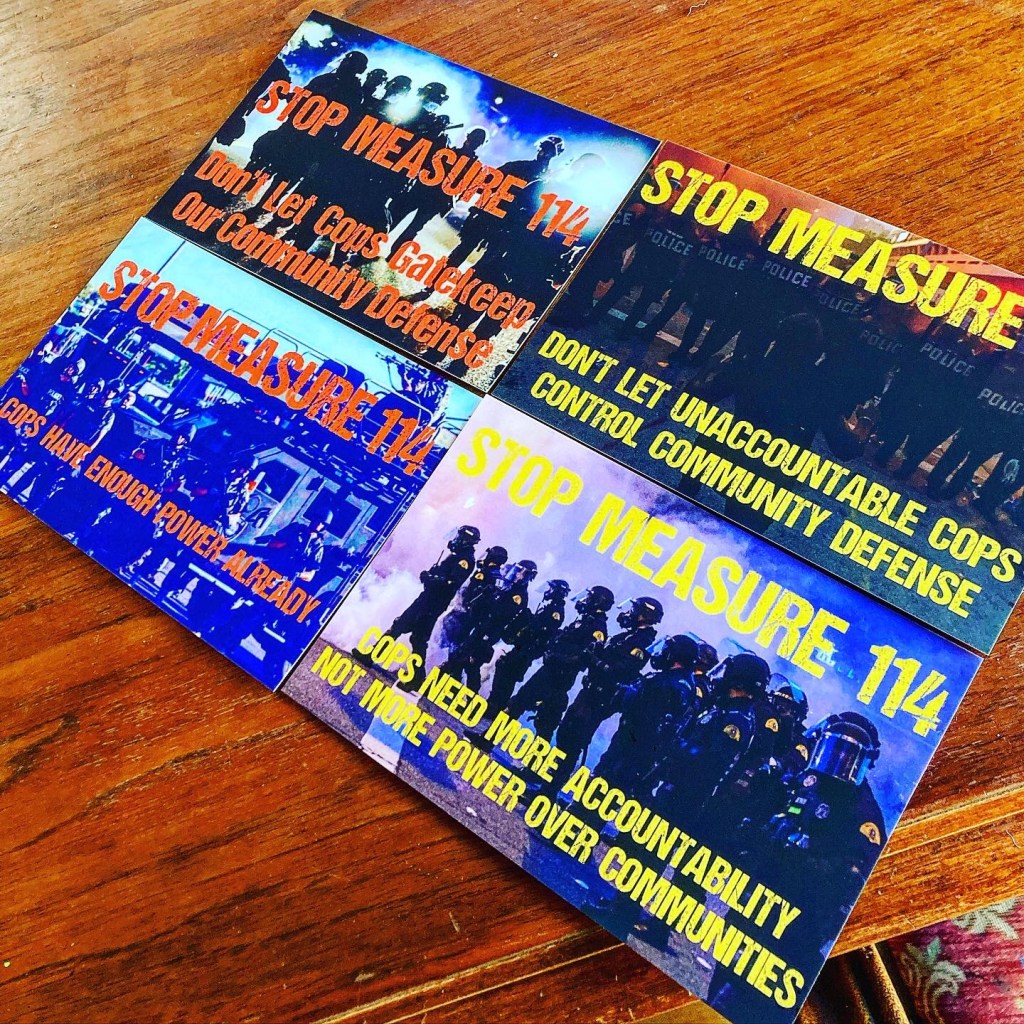
Thanks to everyone who joined in and contributed towards fighting Measure 114. Unfortunately this regressive law passed, though extremely narrowly. Because 114 was written vaguely and potential litigation may slow things down, it’s difficult to say how things will unfold next. However, some issues can be addressed:
1.The Race Factor It’s not just an empty slogan when people say “Gun Control is Racist.” This typically comes into play through implicit bias in policing, yet Oregon has already provided especially blatant examples of this. Sheriffs in several overwhelmingly white counties have declared they will not enforce the measure. Even if they eventually reverse themselves, it will be obvious to rank and file officers what is expected, making Measure 114 a functional law against self defense only where significant communities of color exist.
One of many mailers sent out by pro-114 groups
2. Manufactured Moral Panic One of the most sensational claims promoted by gun control advocates in Measure 114 propaganda is that firearms are now the leading cause of death among children. This is only technically accurate using skewed definitions of the word “children” in two ways. The first is eliminating infants under one years old, whose mortality rate from various causes are higher than gun related deaths. The second is including young adults aged eighteen and nineteen, which bumps the statistics enough to surpass other leading fatalities.
It’s an incredibly cynical scare tactic, considering this age group votes, serves in the military, and in many cases have kids of their own. Gun violence is real and affects too many actual children, but manufacturing data to create a moral panic only makes dialogue towards solutions more difficult.
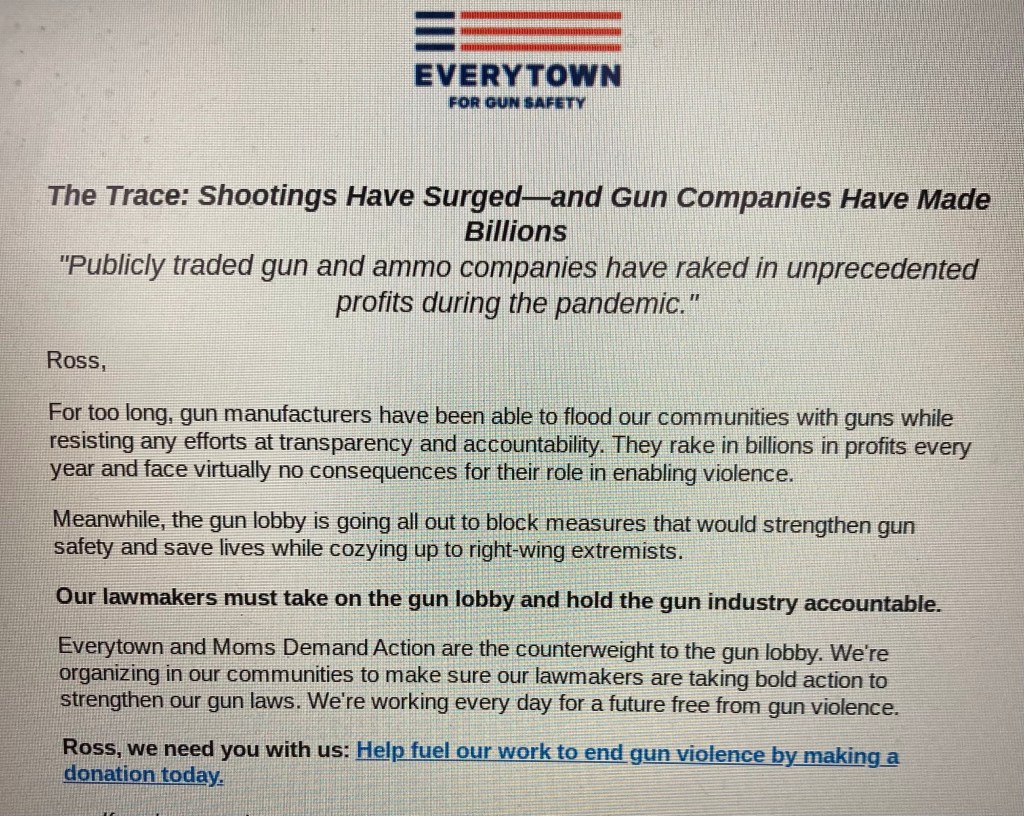
3. Money Talks I subscribe to many gun control email lists and see how fundraising ploys profit from skewed arms industry caricatures. Their carefully crafted image portrays plucky grassroots activists opposing a powerful NRA who bribe politicians with money from shady weapons manufacturers. Yet the numbers don’t match this fantasy. Pro-114 groups raised 2.4 million dollars, while those opposing scraped together just a couple hundred thousand. 114 backers reaped massive donations from billionaire tech magnates and the wealthy financier Michael Bloomberg.
The embattled NRA only ponied up $25,700 and then bungled reporting it, earning an $8,000 fine for their incompetence. The reality is pro-gun groups possess cultural clout but nothing approaching the vast resources of other notorious lobbying groups, such as Amazon or Pfizer. The NRA is a trash fire of racism and greed and operates nowhere near the same level as arms manufacturing behemoths like Lockheed-Martin or Raytheon who have little interest in donating towards 2nd Amendment causes.
4. Delays Can be Dangerous On December 8th all legal gun sales in Oregon will halt, unless some last minute injunction delays the measure. It’s unclear when they will continue, placing anyone who might need emergency self defense in a precarious situation.
Many times people have approached me for gun training who never thought they needed a firearm until something dramatically changed in their life. Perhaps stalking and violence from an ex-partner, with subsequent dismissiveness from the police. Perhaps a sudden barrage of death threats from fascists and discovering their home address broadcast on the internet. People in immediate danger must either face it unarmed or potentially buy illegal guns on the black market, further placing themselves in legal jeopardy.
5. Unintended Consequences Oregon hasn’t elected a Republican governor since 1982 and Democrats enjoy a lockdown on every statewide office yet this time their candidate Tina Kotek barely edged out her main opponent. Most analysis of this faults Betsy Johnson, a former Democrat running as an independent who possibly drew more votes away from Kotek than her Republican challenger.
Interestingly, Johnson was a very pro-firearm voice in the state senate who acknowledges owning a machine gun. In 2012 she spoke to the annual national meeting of the Liberal Gun Club in Portland, which I attended, and recounted hanging a pink bandoleer full of toy ammunition in the senate cloakroom to annoy anti-gun Democrats.
Laying blame on Johnson for denying Kotek a landslide victory is easy, yet left unexamined is how Measure 114 galvanized conservative voters. For example, Measure 111 guaranteeing affordable health care barely passed and even Measure 112 which removed slavery from the constitution only received a 55.6 majority. When gun control laws appear on the ballot, they endanger actual progressive issues by associated backlash and even Democratic candidates in ordinarily friendly territory.
My brief article below will appear in the official Oregon voter pamphlet opposing Measure 114 during the upcoming elections this November. I currently have a GOFUNDME to help offset that considerable expense.
Rising Fascism Makes Community Defense Necessary
Between 2005-2010, I published a ‘zine called American Gun Culture Report. My writers were overwhelmingly folks of color, LGBTQ and others who owned firearms because they cared about community defense and knew the violent history of gun control being used to disarm persecuted populations.
Since those years, I have been contacted by countless individuals sharing stories about using guns to resolve dangerous situations. Typical were examples close to me. One friend pointed her shotgun at a man who broke into her house, scaring him away, and another friend recently drew his pistol on a knife wielding man attempting a gay bashing attack, holding him until police arrived. In none of these cases were shots fired and a firearm ended the confrontations peacefully.
Many people told me they kept such stories themselves, because there is such a harmful stigma connecting guns with conservative politics. There are easily available statistics about firearms being used for terrible acts, yet none documenting how often they save lives. However, just a brief look at American history demonstrates the important role armed defense has played, from the Appalachian Mining Wars to Mississippi Civil Rights struggle. In more recent times, I have provided firearms training out in rural parts of Oregon where immigrant communities exist under regular threat from Right wing groups and law enforcement is distrusted or simply unavailable.
But gun violence finally touched my life. Last February, a dear friend was shot and almost killed at the hands of a fascist mass shooter who opened fire on a peaceful police accountability protest at a Portland park. One woman died and several others were wounded before antifascist security used their AR-15 to quickly stop him. If Measure 114 were in effect, my friend and many others would surely be dead.
Before voting, please consider all the consequences.
Thank you for your time.
Ross Eliot
I will write a more comprehensive article detailing problematic issues with Measure 114, but in brief they are:
Police issued permits – Currently any Oregonian who passes an extensive background check through the federal NICS database can purchase firearms. 114 gives cops complete power to create their own secondary system, keep files on individuals and deny applicants using their own criteria. Given abuses widely documented among law enforcement, this would create an environment ripe for further corruption. Police could easily restrict permits to preferred individuals and deny others without oversight to determine if people from particular racial or ethnic groups, religious backgrounds, LGBTQ status or political affiliations were being screened out. It’s particularly alarming given the open collusion often seen between cops and militant fascist groups, not to mention the high domestic violence rates among officers, making them even more suspect in determining who should be allowed self defense rights.
Magazine restrictions – 114 bans magazines over ten rounds, which eliminates those used in the majority of firearms. It allows those already owned, but as there is no realistic way to document when, perhaps decades old purchases took place, this further gives the police questionable power. To provide perspective, there are currently millions of magazines over the limit in Oregon . Most gun violence either involves suicides or under ten shots being fired, so this law makes very little practical sense, other than making community defense more difficult.
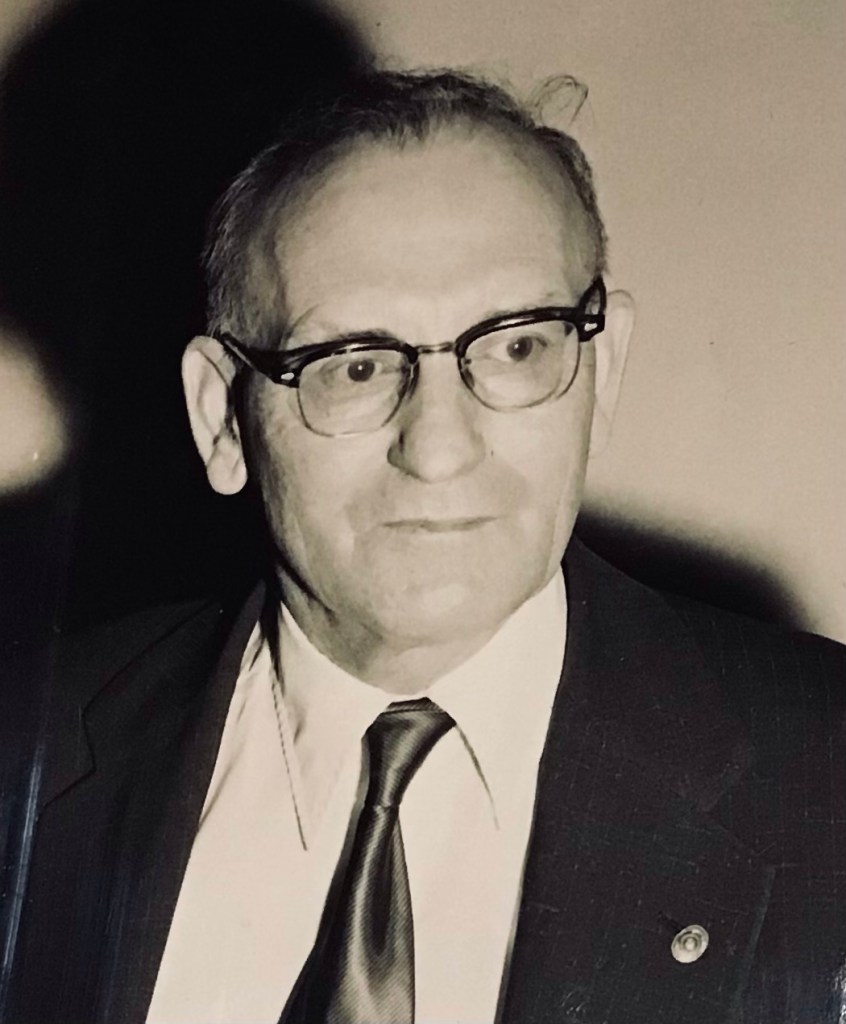
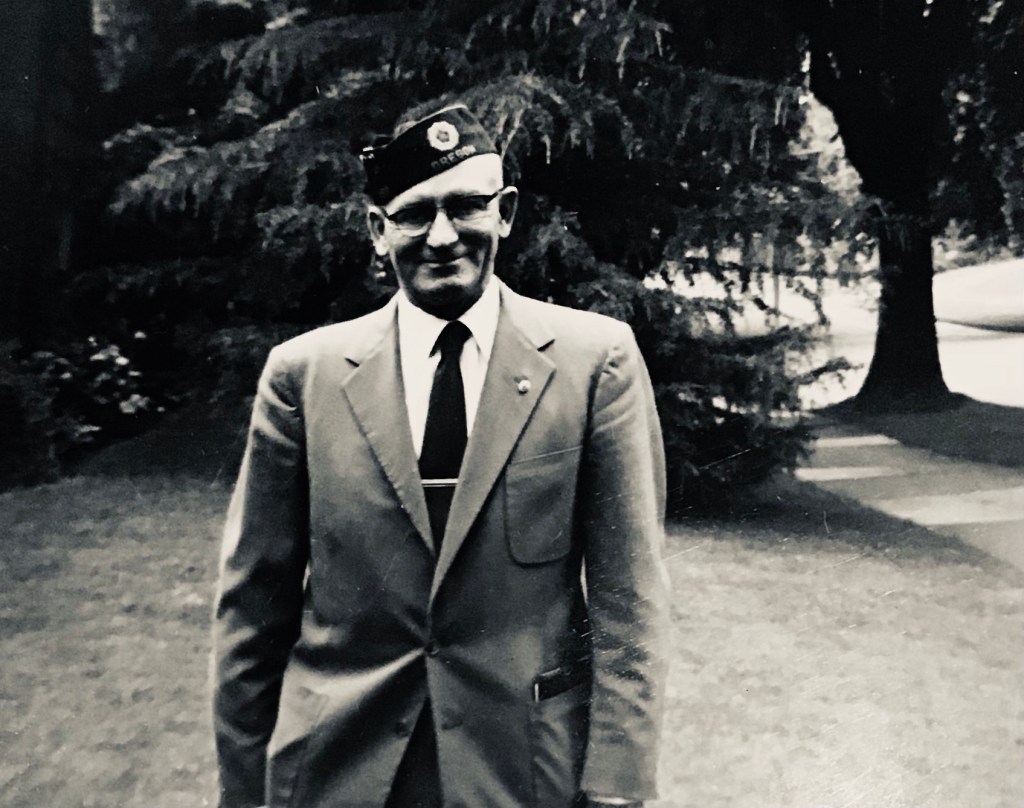
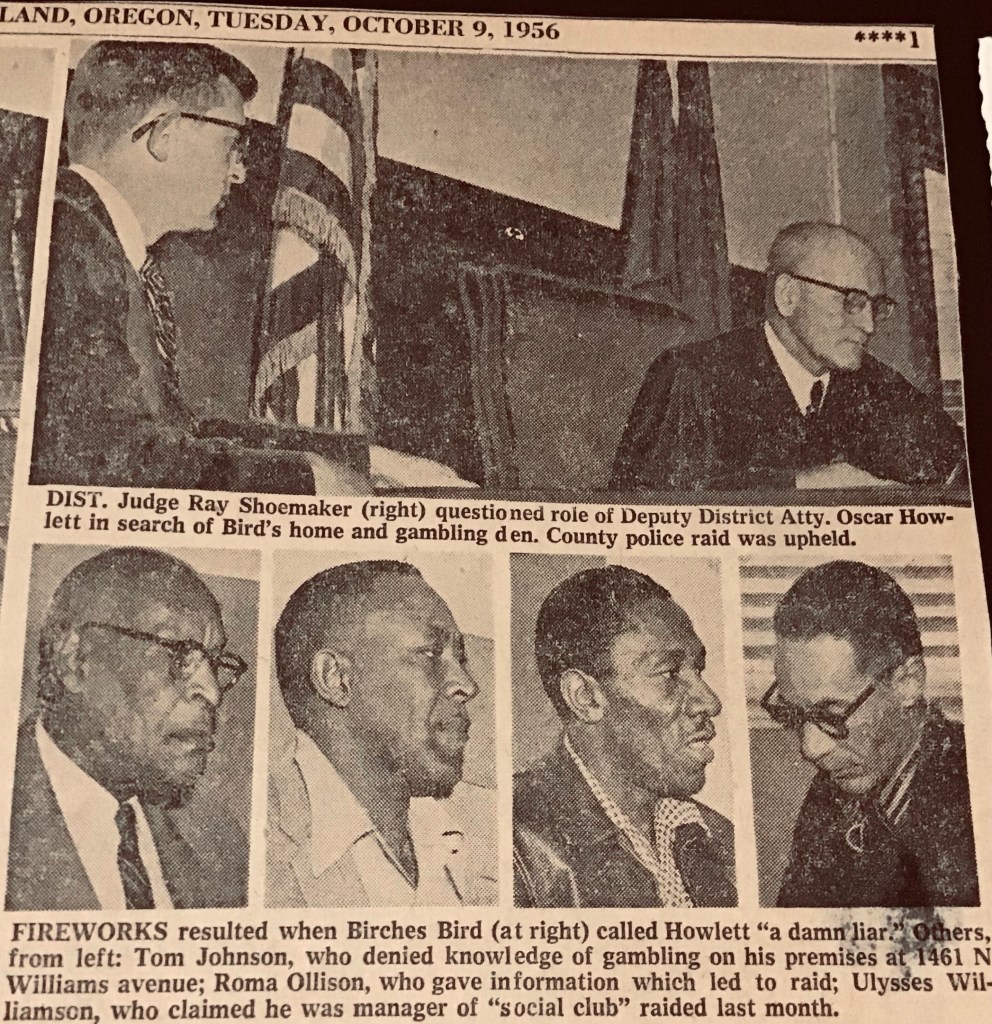
Raymond Duncan Shoemaker, (1894-1977) hardly fit common stereotypes of a political radical. Yet in 1959, this respected judge accused local police of attempting to run Portland, Oregon like a police state, igniting a public feud sixty years before Black Lives Matter dragged law enforcement accountability into the national conscience. It was no singular outburst, but instead represented one fair minded man’s long time effort to enact social justice from within the legal establishment.
Raised near Glasgow, Montana, Shoemaker never cut an imposing figure, with a slim build and standing only 5’6” tall. Still, he gravitated towards heavy industries, employed on local cattle ranches and the Great Northern Railroad in his youth before traveling to Colorado where he labored in the Durango gold mines. Already curious about different peoples and cultures, he spent time learning Spanish from his co-workers. By 1916, at age 22, Shoemaker returned to his home state and joined the 2nd Helena, Montana contingent of the National Guard shortly before their deployment into Mexico during what became known as the Punitive Expedition.
This came about following many decades of political coercion and military conquest, through which the United States reduced Mexico’s territory by about 50%. Unsurprisingly, economic and social turmoil became common during those years, culminating in the Mexican Revolution (1910-1920). Various political factions and figures colored that conflict, but none more famous than the insurgent leader Pancho Villa.
Villa naturally considered the border an illegitimate boundary and didn’t restrict military operations below it. The US government also ignored borders when convenient, most notoriously with its invasion and occupation of Veracruz in 1914. Then in 1916, Villas’s troops raided the town of Columbus, New Mexico, creating mass public outcry for vengeance. Subsequent National Guard mobilization eventually pulled young Ray Shoemaker far from home on a futile chase that drew US soldiers deep into hostile territory.
Shoemaker learned much from the experience. His Spanish fluency proved useful communicating with locals and only furthered a fascination to explore other cultures. He remained in military service through World War I, earning the rank of corporal. All these life experiences made him what people in those times called a Free Thinker.
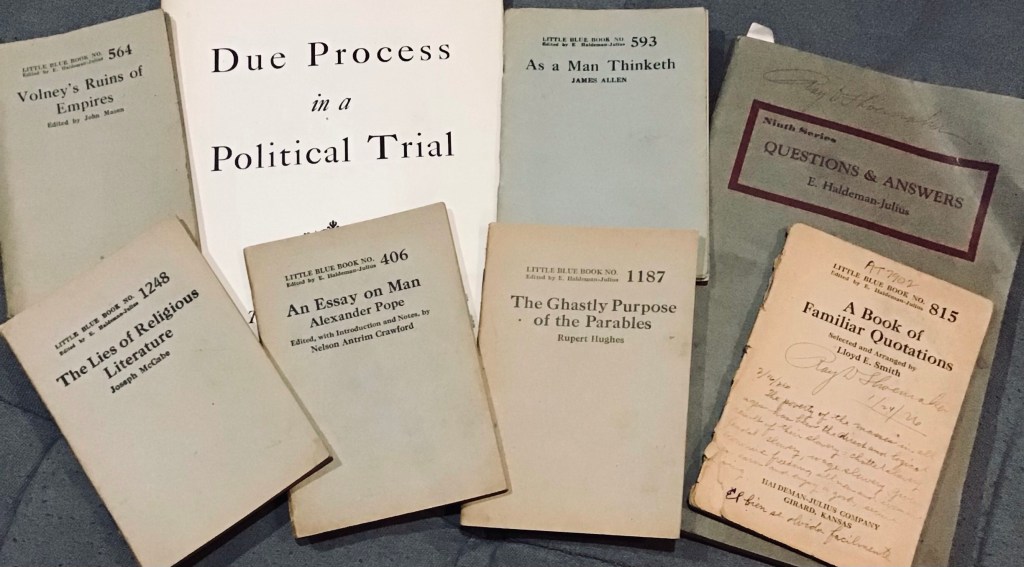
This loose term encompassed many political stances later considered liberal, such as opposing racism, advocating for women’s rights, supporting organized labor, and deep religious skepticism. He avidly read leftist and anti-fascist literature, including the Little Blue Book series published by the socialist writer E. Haldeman-Julius. Shoemaker made extensive notes in English and Spanish between the margins of particular favorites, from The Lies of Religious Literature to The Ghastly Purpose of the Parables and Volney’s Ruins of Empires.
Shoemaker focused on veteran’s issues, joining the American Legion in 1919, the same year it was founded. However, his concern for comrades-in-arms didn’t equate a militaristic mentality. During the mid 1920s, he dashed off the lines:
How cruel are most of man’s emotions,
How mad are many of his ways,
But the cruelest of all his silly notions is war.
Shoemaker began studying law and was admitted to the Iowa bar in 1923. He married, had four sons and a daughter, then lived in California for a time before moving to Portland. All the while his political consciousness developed, in 1926 writing:
The poverty of the masses in all ages has been the direct and logical result of their slavery = chattel slavery, feudal slavery, wage slavery. [G]iven economic freedom, all men and women can earn and enjoy a good, secure living.”
In another comment that year, he was even more direct, stating:
Man must improve with the times, and the relationship of men to property must change = or the majority must get off the earth, because no food will be allowed them.
While other Americans adopted more drastic left or right-wing politics as the Great Depression spread during the 1930s, Shoemaker remained optimistic social change could occur within existing systems. Then, once the US entered World War Two in 1941, his anti-war ethics were tested. Shoemaker viewed American imperialism skeptically but saw German and Japanese fascism as greater threats to humanity. All of his sons enlisted in the armed forces and, by now too old for combat duty himself, Shoemaker served overseas as a Chief Yeoman with the famed Navy construction battalion, the Seabees.
After the war, Shoemaker took up practicing law once more and by 1951, became notable enough that when a circuit court position opened, Oregon’s governor appointed him. This awarded rare institutional power to a true believer from the old Free Thinker movement. Still, what difference could one judge make? Besides that, Portland’s police department was notorious for right-wing connections, after openly deputizing Klansmen in the 1920s to unofficial “Red Squads” who monitored domestic political activity. Even its first union president in 1942 was a longtime member of the German-American Bund, a Nazi party offshoot who marched with swastika banners and fought anti-fascists in the streets.
Portland also held a reputation for organized crime activity in those years. FBI investigations and even a US Senate Committee probe five years later revealed corruption spreading deeply from the top down. Illegal gambling halls operated semi-openly, with payoffs to beat cops who looked the other way. Any reasonably savvy official in the criminal justice system understood this and Shoemaker was no fool. In 1952 he penned a frustrated editorial titled: “Judges Under Wraps” declaring:
It seems absurd that a judge who holds his position because of his fairness, impartiality and integrity should thus be compelled to sit as a helpless referee, unable to express an opinion or judgment upon fallacious arguments, palpably false stories, or in any way to guide the investigation or help the jury to ascertain and determine the truth.
If anything defined Shoemaker’s early years on the bench, it was great kindness. Local media reported about how on April 22, 1952, he relocated his entire court proceedings to the living room of a housebound woman and later that year showed mercy on a man whose truck operator’s permit was revoked because of epilepsy. Many times he threw out cases against minors possessing alcohol or situations involving expired licenses. Other judges took a harder line with offenders, from levying hefty fines and long sentences to requiring “greasers” shave their distinctive haircuts before appearing in court. When Shoemaker saw crimes as victimless, he typically reduced or waived financial penalties and prison time.
For Judge Shoemaker, by then divorced, his personal life took a major turn on July 3, 1952 when he married again, this time to Frances Bertram Hine, a woman thirty-one years his junior. Preferring the name Billie, she came from an East coast family and worked as a Spanish teacher and swimming instructor. Their relationship was quite tender, and many intimate letters between them survived. A great purveyor of nicknames, she dubbed him “Fuzzy” and Shoemaker in turn addressed letters to her as querida, Spanish for dearie. Over the years, media accounts treated their bilingualism as a great novelty. On one occasion where the judge conducted a wedding in Spanish, Shoemaker seemed bemused at the sensation this caused, making an apology that his Arabic and Thai were terribly rusty.
Billie Shoemaker in 1957
Interestingly enough, Billie’s father, Henry Francis Hine, was a prominent clergyman from the Anglican church who delivered a public address in 1940 labeling atheism “the real Fifth Column” before claiming “The only reason our country is still free from enslavement is the church…” It presumably caused quite a shock discovering his new son-in-law was an atheist. Despite this glaring difference, the two men developed quite a warm friendship, attested throughout personal notes and family photographs.
Shoemaker in 1954
Over the next several years, Judge Shoemaker grew less wary of controversy. In September of 1956 he infuriated the Oregon Temperance League after returning alcohol to an underage married man, explaining to news outlets, “It is my opinion… that any man with a family and a job who is supporting his family, doesn’t come within the spirit of the law prohibiting minors under 21 from having liquor in their possession.”
That same month police officers raided an establishment connected with gambling in North Portland. The four arrested men were Black and given well known corruption in that industry, it wasn’t surprising initial evidence connected two white city officials, who denied involvement and were apparently not investigated further. This bust drew much sensational press coverage so it made quite a splash when Shoemaker released the men with only minor fines and even returned cash that police seized, but never connected with illegal activity. One irate local minister even delivered a sermon fiercely condemning the judge.
In Shoemaker’s next published letter, during September of 1957, he called white crowds protesting Black children attending an integrated school during the Little Rock Nine affair “beasts.” His anger came across so strongly that a reporter pressed him some days later, apparently seeking a more conciliatory spin. Shoemaker responded with a personal example, citing one recent case where an all white jury found two Black defendants innocent, despite the aggrieved party being a “good-looking, well-dressed white woman…”
Also in 1957, Shoemaker revisited a favorite subject, advocating more understanding for young people, pointing out in an editorial: “I have heard many respectable adults brag a little about their own youthful exploits beyond the law” He urged less public funds be spent incarcerating minors and instead direct resources toward improving schools and better mental health treatment for “disturbed” individuals. By now, it was apparent the judge posed a regional political influence. Newspapers reported Shoemaker’s opinions on most any matter and even kept readers regularly informed about construction progress of a swimming pool at his house.
More importantly, 1957 was the year of accountability for many prominent officials involved with organized crime, including the police chief, indicted for “incompetence, delinquency and malfeasance in office.” So Portland’s Free Thinking judge grew even bolder. In April of 1958 he wrote an article condemning fascism, as recent surveys indicated many Americans believed “some super-authority should decide what is best for the people. . . that freedom of the press should be abolished. . . . [and] that some people should be denied free speech.” He particularly warned against increasing police powers to search individuals and advocated a more communal mindset among youths “whose duty it is to preserve the freedom we can so easily lose.”
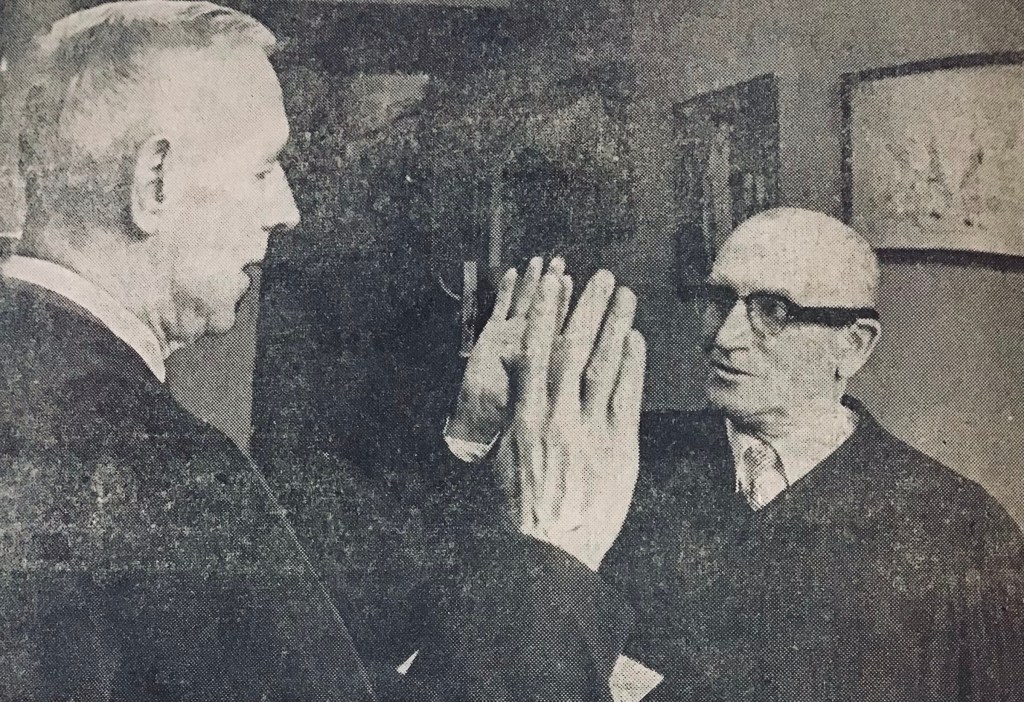
Shoemaker being sworn into office after reelection in 1958
An example of the policing powers Shoemaker feared soon arrived. Around late March of 1959, a radio personality named Alfred Alexander spied an intoxicated man prowling near his neighbors’ house. He confronted this individual who reacted belligerently. The encounter turned violent, with both men trading blows until the interloper revealed himself as Officer Wade Chatfield before placing Alexander under arrest for assault. The station deputy who booked Alexander reported Chatfield had been drinking, was off duty, and wearing plainclothes while apparently earning extra cash as a process server which explained his snooping.
Shoemaker summarily dismissed all charges against Alexander. The radio host then filed a lawsuit of false arrest, which also named Multnomah County Sheriff Francis Lambert. Unfortunately for Alexander, a less sympathetic judge deemed his complaint groundless and Chatfield received no further known consequences, though Lambert eventually forbade his deputies from “moonlighting.”
The police saw Shoemaker’s intervention against one of their own as a declaration of war. Sheriff Lambert certainly felt threatened, yet hesitated before taking action personally. Officer Chatfield’s drunken escapade made law enforcement look bad and further scrutiny might increase demands for civilian oversight. So Lambert waited until a better excuse came along. Street level cops, however, were far less cautious. They launched an unofficial strike against Judge Shoemaker beginning May 1st which almost immediately dropped his traffic offense caseload by 75%.
Then, after turning a blind eye or possibly encouraging their conduct for several weeks, Sheriff Lambert announced a formal police boycott on Shoemaker’s court on May 28, 1959, which he termed too “lenient,” declaring “all traffic and misdemeanor arrests” would be rerouted to Gresham. When questioned for specifics, Lambert claimed two of his officers were poorly treated when they visited Shoemaker to dispute his handling of a “motorist charged with reckless driving and resisting arrest.”
Shoemaker acknowledged the encounter and pointed out “it is the job of deputies to arrest a man, and not judge the case in court.” The judge sharply added he considered attempting “to discuss a case after it has been disposed of” to be “contempt of court.” He declared Lambert’s boycott unconstitutional, pointing out: “The law requires that the arrested person be taken to the closest and most convenient magistrate.”
Officers began making anonymous complaints about Shoemaker, echoing Lambert’s criticism and adding: “He makes a fool out of you in court and makes accusations against you so that it seems you’re the one on trial instead of the accused person.” Shoemaker fired back, stating: “A judge has a duty to stand between the public and some of these deputies who want to make a police state out of this country.” Amidst all this, one State Representative stepped forward in support, claiming Lambert’s actions “smacked of [an] attempt to intimidate the judge.”
News reports claimed officers who supported this boycott were “in the majority.” Still, it’s unclear how Lambert expected a police mutiny would play out long term and his resolve quickly faltered. Within twenty-four hours, Lambert called off the boycott following a “peace parley” arranged by the local district attorney. It concluded in victory for Judge Shoemaker who denied any wrongdoing and made no promise to run his court more harshly. When questioned, Sheriff Lambert “declined comment on the settlement.”
Their feud ignited again in October 1960 after officers chased a man for speeding who became verbally abusive once pulled over. They towed his vehicle, which was apparently not typical. When Shoemaker heard the case, he bristled, interpreting this as petty abuse of authority and struck the impound fee off a $25 traffic fine (around $222 today). The cops argued, with predictable results from Shoemaker, so they next brought their complaint to Sheriff Lambert.
Lambert assailed Shoemaker publicly, this time threatening to file an affidavit of prejudice, adding that he wanted “to get along . . . . but it is apparent that the public interest is not being served.” Shoemaker responded, framing the incident as an unjust confiscation of private property, saying officers did not have “the right to tow the car just because the man gave them a little lip.” He wondered why Lambert lacked enough “grace” to simply discuss their disagreements before “issuing press releases” because“it is up to the courts to protect the rights of individuals and the sheriff is not going to tell me how to run my court.” Once more, Lambert backed down, earning the sensational newspaper headline: “Sheriff Drops Plans to Attack Judge Here.” In 1962 he chose against seeking election again.
Judge Shoemaker continued conducting court as he saw fit and in 1964 was reelected with a popular landslide. Then, life took an unusual twist. Around the mid-1960s, his wife Billie began an affair with Dr. Babette Ellsworth, a prominent university professor. In those days Ellsworth was known for regional geology and history expertise but later gained fame as a transgender pioneer. The two carried on a romantic relationship, eventually gaining Shoemaker’s knowledge and consent. By 1969 the judge retired and in 1971, Dr. Ellsworth moved into his and Billie’s home.
Years later Ellsworth recounted how this dynamic unfolded: “Shoemaker took me into his office privately. He explained his wife loved me and as a wilful individual, would certainly leave him if forbidden to see me… He feared solitude and proposed a solution. I could reside in his house and we would all make the best of things.”
Over the next several years Dr. Ellsworth and Billie took care of the former judge as his health declined. It’s unclear how their relationship avoided scandal, as in times past, even Shoemaker family Thanksgiving plans made the papers. This shift was simply mentioned without comment, as seen in a 1973 article where Dr. Ellsworth and Billie were photographed grinning widely as they pedaled together down a country road. A reporter noted the pair “ride their old bicycles together on Sauvie Island most weekends.”
In 1974 all three took a road trip through Montana, stopping in Glasgow where local media honored Shoemaker’s return with some fanfare. He toured the town, pointing out changes in scenery and reminiscing about the old days. Then on April 30, 1977, Ray Shoemaker went for an afternoon walk around their neighborhood and immediately suffered a fatal heart attack upon returning home. One of the last Free Thinkers would never again infuriate Portland’s police department or dispense courtroom mercy to those in need. A man who told the newspapers upon retirement: “I’ve always felt a just judge has to have a kind and understanding heart.”
In retrospect, it’s worth examining how he got away with everything. After all, Shoemaker was a former Colorado miner whose fellow workers were machine-gunned by private militias and the US military some few hundred miles away during the Ludlow Massacre of 1914. He was a leftist who made powerful enemies among law enforcement during the “Red Scare” when many other careers were destroyed over hints of so-called “Un-American activities.” The answer draws largely from deep reservoirs of goodwill he spent decades cultivating and deep roots in respectable civic groups.
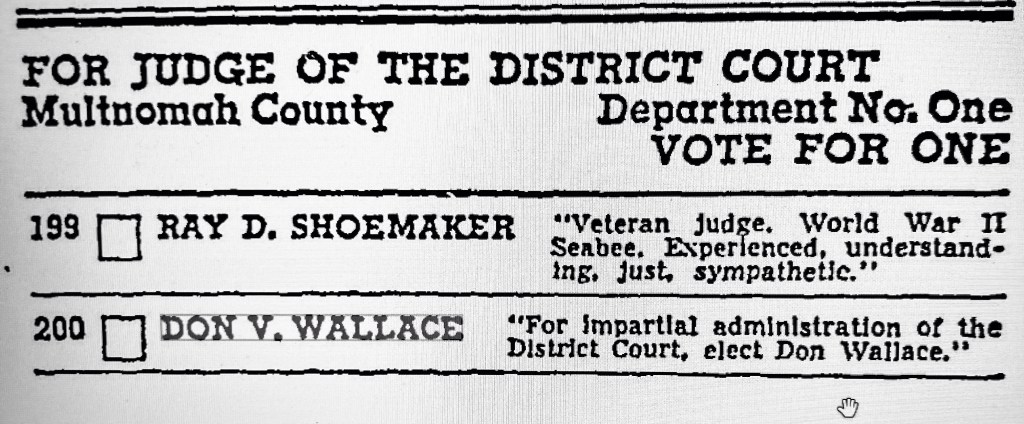
Shoemaker was a devoted member of many fraternal organizations, particularly those with patriotic appeal, from various Masonic groups to the Elks and Eagles. He regularly performed community services, such as visiting high school classrooms to explain the criminal justice system and participating in free legal forums. Simply declaring police officers should operate by the same accountability standards as everyone else and running for election as a “sympathetic, just, [and] understanding” candidate won him great popularity.
Despite his wife’s lover, Dr. Ellsworth, being the subject of various FBI investigations from 1950 until at least 1978, a Freedom of Information Act request indicated no such file existed on Shoemaker. It’s difficult imagining no attempt occurred, given his high profile controversies. In the case of Ellsworth, agents extensively questioned her friends, colleagues and neighbors for information about potentially subversive political views. Though a notable academic figure, Dr. Ellsworth counted on few friends in high places, spoke with a thick French accent, and struck many people as odd, even if her transgender status remained unknown.
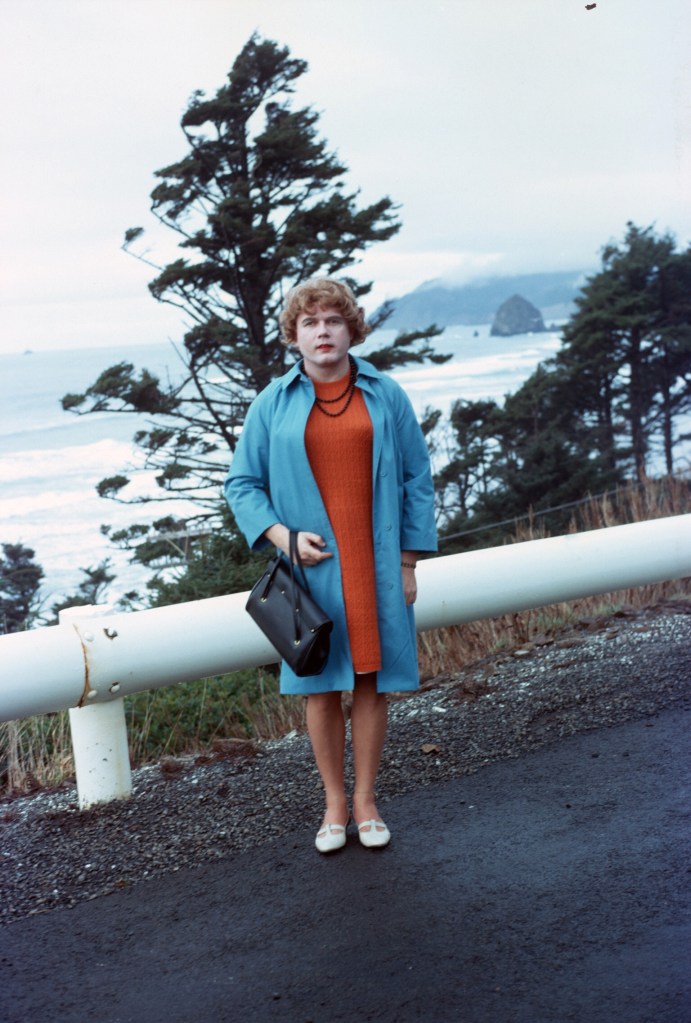
Dr. Ellsworth on the Oregon coast in the mid 60s
By contrast, the judge boasted numerous influential allies, besides serving as a longtime American Legion commander. If suspicious officials ever visited his Montavilla Post #163 to pose insinuating questions, they likely found an unreceptive, if not hostile audience. Shoemaker also avoided making systemic criticisms. Even many of his most incendiary comments were phrased in calculated ways. It’s important to recognize that as an American who came of age when consequences for unpopular political speech might be prison or worse, he recognized limits and carefully avoided crossing them.
This may seem like naked self interest…after all, Shoemaker lived a long life, surrounded by comfort in his later years and the companionship of an unorthodox love triangle. Yet at least for those who experienced justice in his court, this judge made a difference, one that still resonates whenever Portlanders stand up for police accountability and insist all citizens be treated equally under the law.
The Judge and Billie, 1954
All citations, references and quotes not from Ray Shoemaker’s personal papers or my own book Babette: The Many Lives, Two Deaths and Double Kidnapping of Dr. Ellsworth are from the The Portland Journal,The Oregonian and The Star newspapers.
Since 2004 I’ve written about gun politics and conducted defensive small arms training among threatened communities. This background provided much perspective on the escalation following Donald Trump’s election which energized domestic fascist movements and set loose waves of assaults against immigrants, minorities and others along the left political spectrum. Everyone knows how this newly respectable xenophobia amplified right wing violence. Mass shootings, vehicle attacks and death threats against groups organizing to protect themselves.
Previously, most conservatives I encountered appreciated my efforts expanding gun culture outside it’s unfairly stereotyped niche of Republicans, rednecks and hillbillies. Now even mentioning that I do such work often draws comments that I should be killed. It’s a real shift. Over recent years protecting groups marching against state sanctioned terror, I’ve lost count of the times big trucks adorned with American flags and Trump banners revved their engines and raced toward pedestrians, only swerving away at the last minute.
The many victims at Charlottesville, El Paso, Charleston, Pittsburgh and the Portland MAX attack, to name only a few, were less fortunate. I know others beaten by fascists or severely injured from crowd control munitions during anti-Trump or Black Lives Matter protests, but always returned home safe myself. Most people close to me also came away relatively unharmed.
That grace period ended last weekend when a Portland man opened fire on activists peacefully demanding police accountability in a local park. He murdered a sixty year old disabled woman and wounded four others, several critically. One of the survivors is a dear friend of mine. She is likely only alive today because a nearby security volunteer shot back and disabled the man before his rampage continued.
Details are still emerging about this individual, but some things are clear. He was a fan of right wing figures and groups, from Alex Jones and Andy Ngo to the Proud Boys, plus idolized Kyle Rittenhouse, another armed man who went out looking to fight anti-fascists. His own longtime roommate has since spoken out, describing a trajectory of increased racism and misogyny that made her fearful, stating she believed the person who shot him “saved my life.”
Most who nurture imagined grievances, like the presidential election being stolen or Covid vaccines containing microchips, or that organized pedophiles are responsible for their woes, don’t engage in physical violence, yet still enable a toxic conspiracy culture. It took purely insidious motivation to convince someone that a sixty year old walking with a cane presented some threat requiring gunfire to solve.
I have much more to say about that, but at least there is one concrete thing we can do. The survivors here in Portland need financial assistance and if anyone can spare some dollars, I’ve verified that their GoFundMe account is active and going directly to help those affected. Thanks to everyone who can pitch in and help.
Several years ago German Sport Guns, most well known for producing .22 caliber incarnations of iconic firearms, released a 9mm semi-auto version of the MP-40, probably the most recognizable sub-machine gun from WWII. The first available cost around $650 and received terrible reviews. Probably worse than any I’ve seen before. Videos showed the bolt handle flying off, rear sight loose, a terrible trigger, magazines falling out, repeated failures to feed and more. I immediately put the thought of taking such a risk far from my mind. Three years passed and suddenly an ad showed up in my email. It was the prodigal GSG MP-40, only now priced at $477. I checked the internet and discovered new reviewers reported the gun performing quite well. It seemed GSG had gotten their act together.
So I ordered one. When it showed up, the sheer weight felt impressive, yet improvements were definitely required. The charging handle was slender and secured by a weak spring inside the bolt but that proved easy to switch out with a thicker one and more robust spring combination. Likewise the trigger bar took only a few minutes to replace with an improved version. The rear sight seemed solid, with a flip up notch for longer range. It also came with several front sights which are easy to slip in place after removing the barrel nut. Original MP-40s used an under folding metal stock, available now as an extra for those who don’t mind the trouble of a tax stamp. I preferred a side folding SB Tactical brace which is much cheaper, avoids paperwork and aesthetically fits the style.
I headed out to the woods for a range day, with an Evo Scorpion and PSA AKV as sub-gun comparisons. For my first test, I threw in a magazine of FMJ rounds, expecting it might need a break in period. Instead, each shot rattled off just fine, the trigger breaking crisply every time. I ran through three more magazines with zero problems. Surprised but pleased, I switched to a mag of Federal 115 gr. +P+ hollow points. Earlier reviews specified GSG MP-40s struggled chambering FMJ rounds and performed even worse with other varieties. Again, no issues. Next I tried the same experiment with Magtech flat-nosed 95 gr. JSP. They worked great also.
Loading up again with FMJ, I made a serious attempt to make the gun malfunction. Some folks online claimed grasping the magazine at all while firing would cause jams while others suggested holding the extended magwell gently might not. I tried both ways, even gripping the magazine quite hard, yet nothing went awry. I shot it upside down, sideways, slow and rapid fire. The magazines are listed for 25 round capacity, while wartime originals held 32, but I squeezed in 28 several times. No matter what, the MP-40 cycled and went bang every time. All told, we burned through about 350 rounds without a single failure. Not the most exhaustive test, but for the subject of so many dismal experiences several years ago, quite an improvement.
Accuracy was impressive. My partner and I fired casually at cans from about 40 yards and made hits easily. She appreciated how the long forward mass kept it steady in her hands. I definitely agreed. If any contrast appeared between the other guns, it highlighted the advantage that heft ads for follow up shots. My Scorpion is a pure delight, but definitely bounces a bit from recoil. Same with the AKV, though less pronounced, as it has a solid steel fore grip. No such movement from the MP-40. It’s weight could grow annoying slung over your shoulder, but makes double taps feel like it’s tank mounted.
One other interesting aspect are the magazines. The MP-40 came with a plastic loader which I immediately tossed aside, priding myself on always filling mags without such contrivances. Yet, these magazines defeated me. Their follower cants forward in such a way that it binds unless something narrow pushes it straight down between the feed lips, letting cartridges slide into place. I’m sure some other method could be found in a pinch, but the loader does make it easier. I’m unsure why earlier reviewers had trouble with magazines dropping out accidentally. Mine all locked solidly into place, though sometimes requiring an extra slap underneath when inserted on the closed bolt. They slid out easily with a touch of the release button.
Takedown is somewhat annoying. A screwdriver or stout fingernail removes a tiny c-clip allowing the retaining bolt to be hammered out with a punch or dowel. Odds are good that pesky clip will escape forever someday. Before that happens, I plan on replacing the retaining bolt with one I can simply secure with a nut. To make it look more authentic and aid in field stripping, I cut the upper housing with an angle grinder. That makes it unnecessary to remove the charging handle, which is now spring-loaded solidly in place anyway. I’ve read others have chosen to weld it but for now, that seems like overkill.
The safety requires special mention. It’s a 360 degree spinning dial mounted under the receiver just behind the mag well. An arrow points forward for FIRE and crosswise for SAFE, assuming you have time to flip it upside down and check. I used red fingernail polish to highlight the F side and left it black for S which at least allows visual inspection from the side. Still, it’s a pretty questionable system. In times of urgent combat stress, unslinging the MP-40 and verifying its status seems dubious. I’d be curious to know what the WWII German manual of arms suggested regarding that. The best method could potentially be three main conditions.
Option A requires remaining on SAFE while carried at low ready, a round chambered, and one hand below the receiver with support fingers resting on the dial. If enemy contact initiates, one click either way and you’re good to go. Option B would keep the safety on FIRE, with the chamber empty and bolt notched open. Under ordinary circumstances, the MP-40 could be slung that way, yet brought into action quickly by slapping the cocking lever home. Not very stealthy, but potentially less awkward than a haphazard spin of the roulette wheel searching for FIRE in an emergency. Option C is for storage or other low risk circumstances and simply leaves the gun on SAFE with its bold closed and chamber empty.
(above) Partisans with captured MP-40s
The final issue is political. It’s a cop out to simply buy a weapon so heavily tied to Nazism and think no explanations are in order. We live in a time of increasingly violent xenophobia where misguided individuals embrace trappings of fascism while dismissing any scrutiny as unwarranted. I appreciate firearms no matter their origin and have accumulated a variety for training and community defense, but recognize the need to differentiate my MP-40 from others keeping it as a totalitarian fetish. Therefore, I decided to customize the gun in tribute to WWII European partisans who fought bravely against high odds with captured weapons.
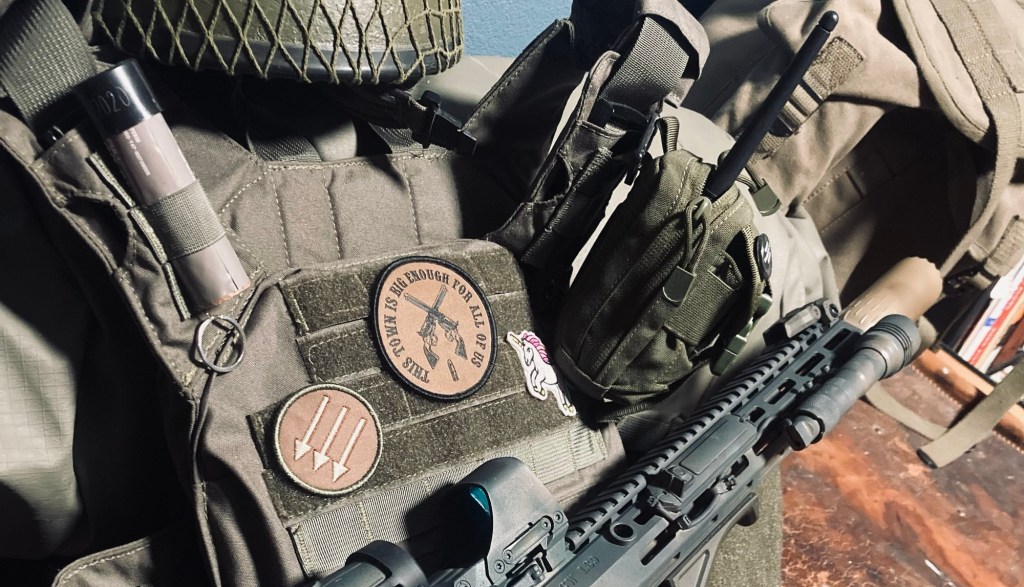
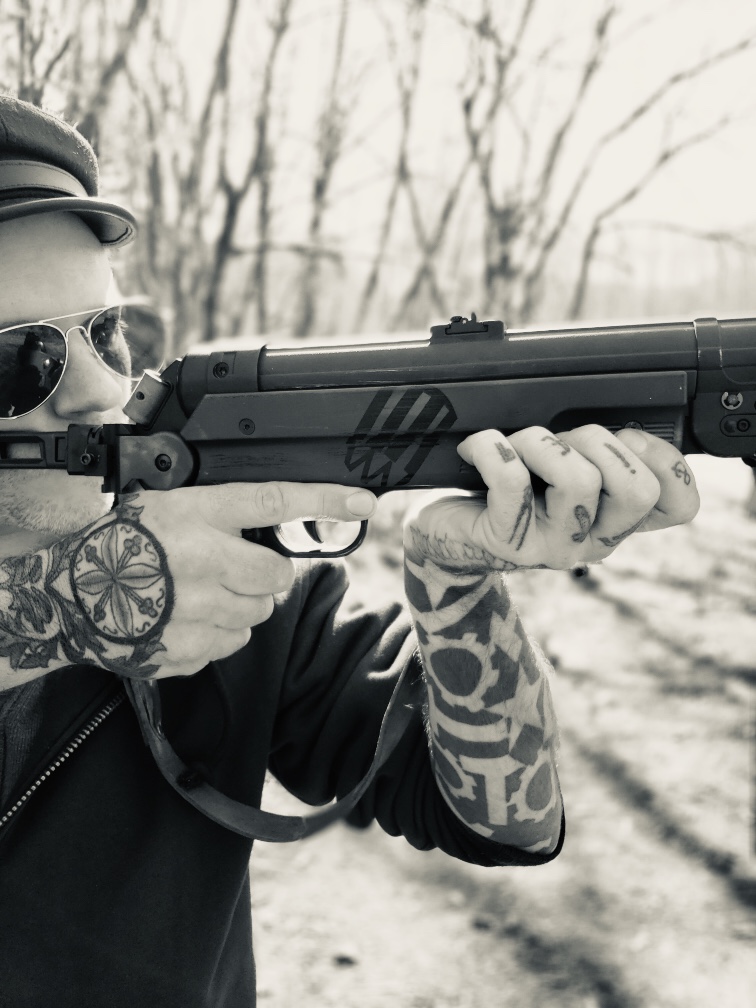
At first, painting the silhouette of a hydra on the MP-40 seemed appropriate, because German anti-insurgency medals from the period depicted a spear piercing this mythical multi-headed beast. Still, a rather obscure reference. It ultimately made more sense to use the well known Iron Front anti-Fascist arrows, broadcasting my affiliation loud and clear. To accompany this aesthetic, I wanted the gun to look as if it had seen action from Italy and Yugoslavia to the Warsaw Ghetto. That entailed painting the original shiny black finish matt grey and then hitting most of the edges with sandpaper for a well worn patina. I also painted the plastic grip, brace and side panels brown before giving them similar treatment.
In the end, more range time will be required before my MP-40s status can be settled. At the moment, it remains an interesting project, significant in the development of modern weaponry, yet more than just a display piece.
Above: this photo earned the author a death threat just ten minutes
after being posted on a sub gun internet fan page.
”Extreme Risk Protection Orders” or “Red Flag Laws” present an interesting form of gun control, currently adopted by seventeen US states. These exist in various forms and allow temporary firearm confiscation, even if no laws were actually broken by the individual in question. They are typically granted by judicial decision at the request of family members, concerned friends or police officers and present one of the few gun control positions enjoying relatively broad support across the political spectrum.
In the two years since Oregon adopted a Red Flag Law, it’s most commonly involveddomestic violence situations or suicide risk. For me, these social issues hit close. I’ve lost friends to suicide and also spent five years working in a women’s shelter. Any means for potentially making violent partners less deadly carries undeniable appeal. Still, I worry about the potential for abuse because laws are only as fair as those enforcing them.
There’s plenty of reasons I feel trepidation. For example, one year ago a resident who was nearly nine months pregnant with an abusive ex-partner’s child, turned up covered in bruises after being beaten by him again. While she cried in the managers office, her ex raged on the sidewalk outside, screaming threats against her and my co-workers. Incredibly, he was still there when a cop showed up twenty-five minutes later. The responding officer then yelled at the woman for being too emotional and on his way out, actually gave her abuser a fist bump. The very next evening, her ex came back with a shotgun and was arrested attempting to break in.
Given the notorious connection betweenpolice officers and domestic violence, this camaraderie shouldn’t be shocking. It’s also worth observing the cop in question and the abuser were both White. The pregnant woman was Black. Of course, it goes deeper than personal anecdotes. There are countless other examples for why law enforcement has accountability problems, fromFerguson,Baltimore,Portland andeverywhere in between.
During times where people distrust police, and Right wing terrorist sympathiesoriginate from the president, it’s unsurprising marginalized communities are banding together arounddefense and mutual aid. Sometimes this involves training with arms.
Now, most sensational outrages by Fascist militants occur against relatively wide targets of opportunity, like the El Paso shooter who drove hundreds of miles to find a favorable location forslaughtering Mexican-Americans or the one who selected a particular Charleston church because of it’sBlack congregation. As terrible as those events were, more dangerous are the less organized acts, a national pogromoccuring in plain sight yet receiving fewer headlines… the rising wave of violence againstpeople of color, immigrants, Jewish and LGBTQ communities.
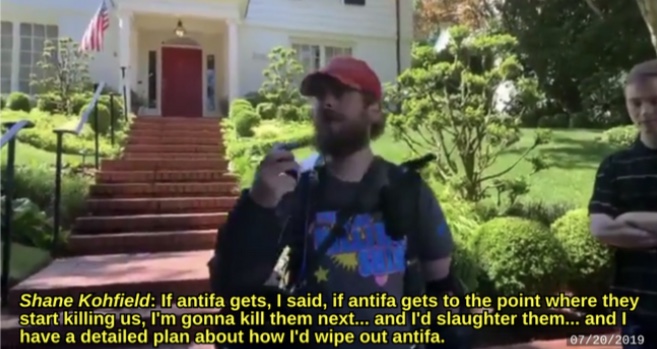
Against this background, the issue of Sgt. Shane Michael Kohfield presents many complications and deserves scrutiny. To sum up, Kohfield is a military veteran experiencing mental illness, substance abuse and PTSD who attended a 2018 Right wing rally in Portland. There, he claims anti-Fascist protesters assaulted him, yet without details of physical injury. Kohfield subsequently wrote a Texas politician demanding “Antifa” be condemned as a terrorist organization and declared if the government didn’t take action, he wouldorchestrate “genocide” against them. The FBI opened a file regarding this. Next he showed up outside the Mayor of Portland’s house while repeating his threats through a loudspeaker. This ostentatious display caused agents to temporarily confiscate his firearms using Oregon’s“extreme risk protection order.”
Kohfield’s case presents a unique political twist. Indeed, Kohfield’s own father testified he posed significant risk of committing murder.* Like many anti-Fascists, I’ve received my own share of death threats, so I’d be lying if the news such a person had been disarmed— no matter by who or how temporary, didn’t provide some satisfaction.
Then this September, Kohfield appeared on theLars Larson show, a Northwest conservative talk radio program. Their recorded exchange iswell worth hearing. Kohfield sounded confused and nearly incoherent at first. Despite everything, I immediately felt badly for him. It should have been obvious this was someone who needed help, not a person in any condition to make public commentary. Instead, Larson vacillated between chiding him for muddled statements and then goading more extreme directions. Kohfield seemed reluctant to restate his earlier violent outbursts, perhaps feeling understandably ashamed, yet Larson prodded him into specifics.
Kohfield: First veterans join Antifa social media pages and groups, and get names of most active members and social media, along with getting the arrest records from rallies and write down all the names they see. The veterans will use background check programs to get all the home addresses of Antifa. Using the intelligence they have gathered, the veterans will take maps of the cities where Antifa are known to live there, grid overlays will be placed over the maps of the cities, the veterans will be broken down into squads, each squad will be assigned a grid and given names and addresses in their assigned grid square. There’s an ap called Route4me that can be downloaded on a phone with the GPS, it is an ap that allows delivery truck drivers to enter more than one address, unlimited addresses and ap plot turn by turn the best route to deliver the packages. The veterans would use Route4me to find the most expedient route to hunt down the most violent members of Antifa in their beds at night until every one was gone in every city in America, if need be, in a single well coordinated night. The losses for Antifa would be catastrophic
Larson: So you are planning to hunt down and kill members of Antifa?
Kohfield: No. No.
Larson: But that’s what you just described!
Kohfield then attempted to backpedal and equivocate his statement, both denying this plan endorsed violence but also declaring anti-Fascists deserved death if they became a lethal threat, something he clearly believed was reality, having earlier claimed “Antifa” chased “conservative” citizens around with knives while being protected by the police. Larson made no attempt to correct his fanciful imagination, but only pressed for more details.
Larson: What do you plan to do to them when you get to their home and they’re asleep in their beds?
Kohfield: According to the plan, it would be kill.
Larson let him ramble on for another 15 seconds and suddenly ended the interview, not before thanking Kohfield for his service.
There’s a lot to be angry about here, and it’s more complicated than the fact an unstable man with military training openly contemplates slaughtering Americans in their beds. While Kohfield seems an obvious villain, Lars Larson more richly deserves that billing. It’s completely irresponsible allowing someone clearly in the midst of a mental health crisis to make murderous public statements that will follow them the rest of their lives. Larson blatantly exploited Kohfield’s disturbed state for radio sensation, without making any attempt to assist the man. Larson is someone with a widespread following who many on the Right take seriously. By not challenging Kohfield’s toxic social delusions, he reinforced the fantasy that “Antifa” represents some sinister organization bent on killing others.
But it’s only a relatively minor news story. One could imagine the national outrage if some progressive radio show let a Leftist militant describe plans for death squads around the country to assassinate sleeping bankers in their homes. Of course, in our consequence-free climate where the current presidentwantonly pardons war criminals, and the previous oneauthorized assassinating citizens without trial, perhaps Americans would accept that extrajudicial killings of anti-Fascists might be an extreme, but ultimately legitimate political stance.
This case also sets worrying precedent in firearms policy. Kohfield brought his threats to an escalated level by broadcasting them at the Portland mayor’s house, yet was convicted of no crime. The question for armed anti-Fascists becomes, at what point does this affect us? For some time there have been movementsby powerful people in government toward declaring “Antifa” a terrorist group. After taking action against a figure on the Right, state agencies may feel political pressure to next target anti-Fascists with “extreme risk protection orders.”
Therefore, we must be very clear about what community defense means and make sure no excuse can be given for authorities disarming vulnerable populations during these fraught times. Everyone should agree:
It’s doesn’t mean assassinating people in bed at night.
It’s doesn’t mean preemptively shooting anyone, no matter their political affiliation.
It absolutely means firearms are for defending against immediate life dangers, not property.
It absolutely means keeping our friends and families safe through mutual aid, training for emergencies and with force as a clearly defined last resort. Guns have their place in the social justice toolbox, but only when all other means have been exhausted.
* Kohfield has disputed this aspect of the story and claims his father was misquoted in media accounts.
“…in the age we live in, a well-displayed villany takes the place of all the finer qualities and the more infamous a man, the more people are disposed to credit him with intellectual force and moral worth.”
-Octave Mirbeau. The Garden of Evil, 1899.
“… you get beatings, burnings… They’re a package. And there may be even nastier things in that package. [His] supporters are more than a little seduced by [his] talk of making America great again.”
Octavia Butler. The Parable of the Talents, 1998.
Lately, current events read almost verbatim from the pages of popular dystopian novels, with themes spanning Margaret Atwood’s The Handmaid’s Tale and George Orwell’s 1984 immediately recognisable. Women’s reproductive freedoms rolled back, violent attacks against minorities increasing, gay rights on the defensive and President Trump’s doublespeak tweets mixing fact and fantasy across a media landscape where anything seems plausible. Mirbeau’s late nineteenth-century observation about the power of naked corruption brandished in full view seldom rang so true. Butler’s prophetic description of an apocalyptic demagogue hits even closer to home.
Yet among fictionalized worst case scenarios is one book most students of English literature are likely less familiar with. That is The Turner Diaries, published originally in 1978 by longtime racist activist William Pierce (aka Andrew Macdonald) and essentially a blueprint for the extermination necessary in creating a White Nationalist future. It’s not the only tome on xenophobic reading lists, with Jean Raspail’s The Camp of the Saints, enjoying high profile popularity (1) lately, but The Turner Diaries carries particular weight. This is because it inspired a murderous White power terrorist cell during the early 1980s and is generally connected with the 1995 Oklahoma City federal building bombing. (2) Not many authors have directed multiple readers toward such sensational militant actions.
While it may seem at present the chance of genocidal warfare is an exaggerated concern, amidst many reasons to oppose Donald Trump, his barely veiled support for White Supremacy tops the list. This began even before the 2016 election and was significant for why conventional wisdom suggested he could never become president. Promoting the bizarrely racist birther attack against Barack Obama was an early indication and it only solidified after Trump showed reluctance to disavow an endorsement from David Duke, the notorious former KKK leader.
In retrospect, this single act (or lack of one) stood out as a stark indicator of the changed world we now live in. Traditionally, most Americans have silently accepted the bureaucratic injustice of prison sentencing disparities and other ways institutional racism occurs, yet in modern times been repelled by overt bigotry, such as represented by the KKK. Still, Trump’s step over that line elicited merely a yawn among supporters and quickly faded, replaced by other scandals.
Trump clearly felt emboldened by the lack of consequence for this and other violations of the norm, like encouraging violence at his rallies, and as his unlikely technical win unfolded, a chilling wave swept across the country. In Portland I first heard about it from local friends of color who recounted strangers making racist comments in public as never before. One local Black woman, who sometimes wears scarves that people mistake for Islamic dress, told me she became fearful taking public transit after multiple people scolded her angrily to “go back home.” Most troubling was another Portland area Black woman beaten with a brick by men who shouted pro-Trump slogans during the assault.
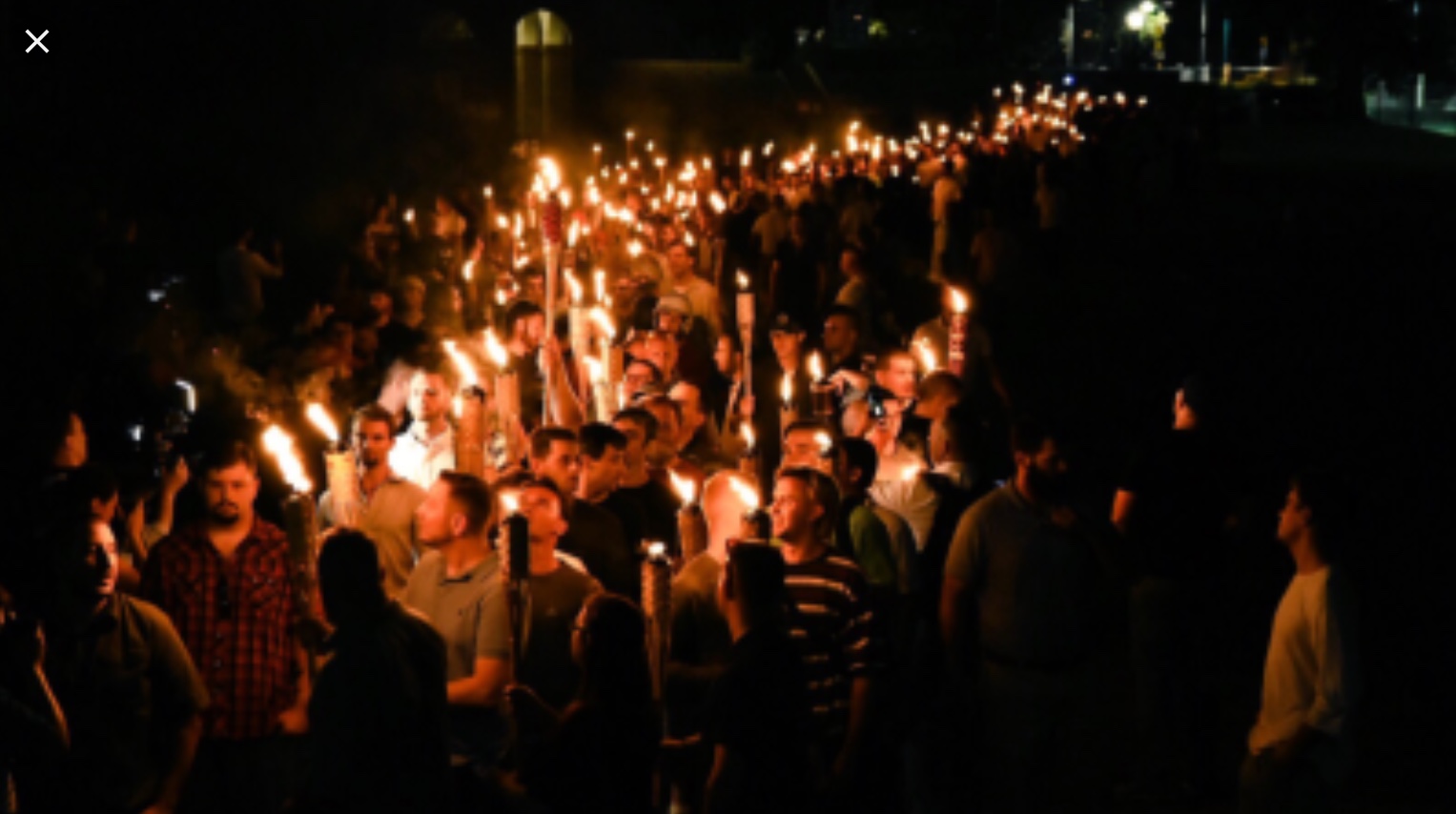
(Above) Unite the Right 2017
Rising violence against minorities is measurable nationally using crime statistics, even down to specific peaks following Trump’s mass rallies. Tragically, the Right wing body count is only growing. Nine killed by a White supremacist at a Black church in Charleston. Eleven murdered at a Pittsburgh synagogue by an anti-Jewish extremist. Even the New Zealand mosque shooter who massacred fifty Muslims cited Trump as inspiration. When asked by a journalist if growing White Nationalism was concerning, the president answered negatively, passing up another moment to distance himself from this toxic movement.
But no one should have been surprised. After one man murderously rammed his car into a packed crowd of of demonstrators protesting the 2017 Unite the Right Rally in Charlottesville, an event organized by White Nationalists, Trump infamously declared both sides equally at fault. In telling priority, one of his first acts as president was defunding programs aimed at countering domestic terrorism, even one focused specifically on neo-Nazis.
There are many disturbing similarities between Trumpism and Pierce’s fictional ideology inspiring Americans toward race war. For instance, while the pages are full of hatred towards Leftists, traditional Conservatives and Libertarians are also marked for destruction. Just as those same elements within the Republican party found themselves sidelined by Trump’s bloc. Indeed, before 2016, most political observers believed he could never even become nominated because establishment forces opposed him as an extremist. Libertarians still experience difficulty accepting his authoritarian leanings and during the election, Democrats expected a landslide victory because Trump seemed to have as many enemies on the Right as the Left. What they missed, after eight years of a charismatic Black man serving as president, was deep xenophobia still buried throughout American society. Every drop untapped political fuel.
(Above) Unite the Right 2017
While Republican policies of old at least paid tribute to limited governmental ideals or limits on centralized power, Trump simply doesn’t bother and his supporters remain unfazed… so long as big government aims its big guns at unpopular minorities. He has many times endorsed religious persecution against Muslims— a dramatic abuse of federal power, and enthusiastically supports state involvement in the economy, both by starting trade wars and then borrowing money to bail out businesses damaged by them.
Of course, Trump’s fiery campaign talk about breaking up banks and regulating Wall Street fell by the wayside long ago. Distractions range from his social media feuds to noisy focus on the southern border, where human rights abuses regularly unfold, dulling public outrage to the sight of corralled humans behind barbed wire in overcrowded camps.
Beyond that, Trump openly admires dictatorial leaders around the globe and has several times stated he would disregard unfavorable election results. Attempts to curb his blatant violations of executive power by other political branches have failed. In short, we are are tasting the emergence of New American Fascism:
– a strong government allied with corporate powers toward
furthering the agenda of an unaccountable figurehead at the
expense of marginalized communities-
While Pierce doesn’t use the term Fascism, it’s very clear his writing aspires toward an idealized version of Germany’s Third Reich. He drops occasional details noting the bravery of SS soldiers, coyly mentions Hitler as “the Great One” (3) and is murderously explicit about how all non-Whites should be wiped out. In the furtherance of this goal, one particular tactic bears current relevance. As The Turner Diaries concludes, Pierce’s race warriors brutally conquer southern California and enact strict segregation policies. They force away all surviving people of color in hopes they will overwhelm national resources, calling this tactic “demographic war.” (4) Anti-Fascists will be “trapped by their own propaganda line, which maintains that each one of these creatures is an ‘equal,’ with ‘human dignity’ and so forth, and must be treated accordingly.” (5)
This is essentially the same idea Trump has advocated by suggesting asylum seekers be diverted into so-called “sanctuary cities.” It’s unclear how this could be accomplished logistically, yet resonates among those who view non-White immigrants as ravening hordes of rapists, instead of simply workers and families seeking a better life. Just as Pierce hoped ‘demographic warfare’ would turn Whites against people of color, this proposal invites discord among urban dwellers, many who oppose iron fisted immigration policies, yet also don’t expect small numbers of localities to reasonably absorb so many newcomers alone.
It’s easy noting connections between The Turner Diaries and rising bigotry today, but much examination still gets important aspects wrong. For instance, a recent NPR segment declared the book is about “Jews and black people who disarm white Americans, take away their guns so that they can’t resist the government.” That’s actually the opposite of what happens. Pierce’s narrative describes how federal anti-gun legislation becomes enacted with the intention of disarming all civilians, but his White protagonists are the only ones who don’t comply. This makes it easy for them to eventually slaughter the ‘Jews and black people’ who trustingly followed the law.
At one point he writes: “…whenever we ran into Blacks near a filling station, we simply opened fire on them . . . It’s a damned good thing they have no firearms or we’d be in a hell of a jam now.” (6) Then later: “…good thing the civilian population was disarmed . . . years ago. If more Blacks had guns there’d be no way we could deal with them…” (7)
NPR bungles such basic elements just as most Democrats and Liberals continue misunderstanding the gravity of our current situation and confuse Trump with some rough incarnation of business-as-usual Conservatism. Fascism is a very different animal. It satisfies an increasingly violent thirst for change among Americans who feel shut out as the middle classdisintegrates and mainstream parties falter at offering real solutions.
Fascism can’t be successfully confronted by following traditional rule books, as should be obvious to those frustrated by the lack of legal consequences for Trump’s contemptible acts. This isn’t the old days where a president like Nixon could be brought down by intrepid reporters discovering some hidden crime that shocked the nation. Trump’s criminality take place in the open and crowds cheer him for it. Just as Fascism represents nontraditional alignments of Right wing power, robust and flexible Leftist politics are required to defeat it.
The Turner Diaries envisions a scenario where relatively small numbers of Fascists defeated enemies who lacked such flexibility. Trump’s administration grinds onward despite widespread unpopularity for the same reason. Timidresponse from the Democratic party are ineffective, only emboldening Right wing reaction. Everyone who struggles against the New American Fascism must keep all options on the table and remain armed because White Nationalism goes hand in glove with genocide. The dangers have never been so real within most of our lifetimes.
Note: I will be commercial fishing in the Gulf of Alaska for most of the summer and unlikely to post again for a while. Thanks to everyone who reads along and joins in!
1 Trump administration insider Steve Bannon positively reviewed it, for instance.
2 Timothy McVeigh read the book and even sold copies to others. His bombing attack bears similarities to an event described in the text but McVeigh never linked his personal anti-government sentiments with racist politics. A review of The Turner Diaries on one prominent White Nationalist website admits he was a “non-racialist” and the Leftist journal Race Traitor declared McVeigh “did not appear to be a white supremacist . . . He did not bomb a black church. He did not plant a white bomb.” John Garvey. “The Life and Death of Timothy McVeigh.” Race Traitor, Fall 2001. 7.
3 Andrew Mcdonald. The Turner Diaries. Barricade Books, NJ. 1996 (1978 original) 210.













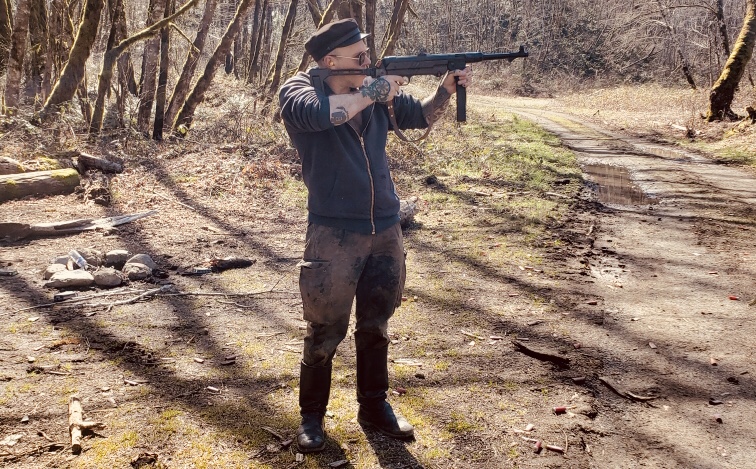
 I headed out to the woods for a range day, with an Evo Scorpion and PSA AKV as sub-gun comparisons. For my first test, I threw in a magazine of FMJ rounds, expecting it might need a break in period. Instead, each shot rattled off just fine, the trigger breaking crisply every time. I ran through three more magazines with zero problems. Surprised but pleased, I switched to a mag of Federal 115 gr. +P+ hollow points. Earlier reviews specified GSG MP-40s struggled chambering FMJ rounds and performed even worse with other varieties. Again, no issues. Next I tried the same experiment with Magtech flat-nosed 95 gr. JSP. They worked great also.
  Accuracy was impressive. My partner and I fired casually at cans from about 40 yards and made hits easily. She appreciated how the long forward mass kept it steady in her hands. I definitely agreed. If any contrast appeared between the other guns, it highlighted the advantage that heft ads for follow up shots. My Scorpion is a pure delight, but definitely bounces a bit from recoil. Same with the AKV, though less pronounced, as it has a solid steel fore grip. No such movement from the MP-40. It’s weight could grow annoying slung over your shoulder, but makes double taps feel like it’s tank mounted.
  The safety requires special mention. It’s a 360 degree spinning dial mounted under the receiver just behind the mag well. An arrow points forward for FIRE and crosswise for SAFE, assuming you have time to flip it upside down and check. I used red fingernail polish to highlight the F side and left it black for S which at least allows visual inspection from the side. Still, it’s a pretty questionable system. In times of urgent combat stress, unslinging the MP-40 and verifying its status seems dubious. I’d be curious to know what the WWII German manual of arms suggested regarding that. The best method could potentially be three main conditions.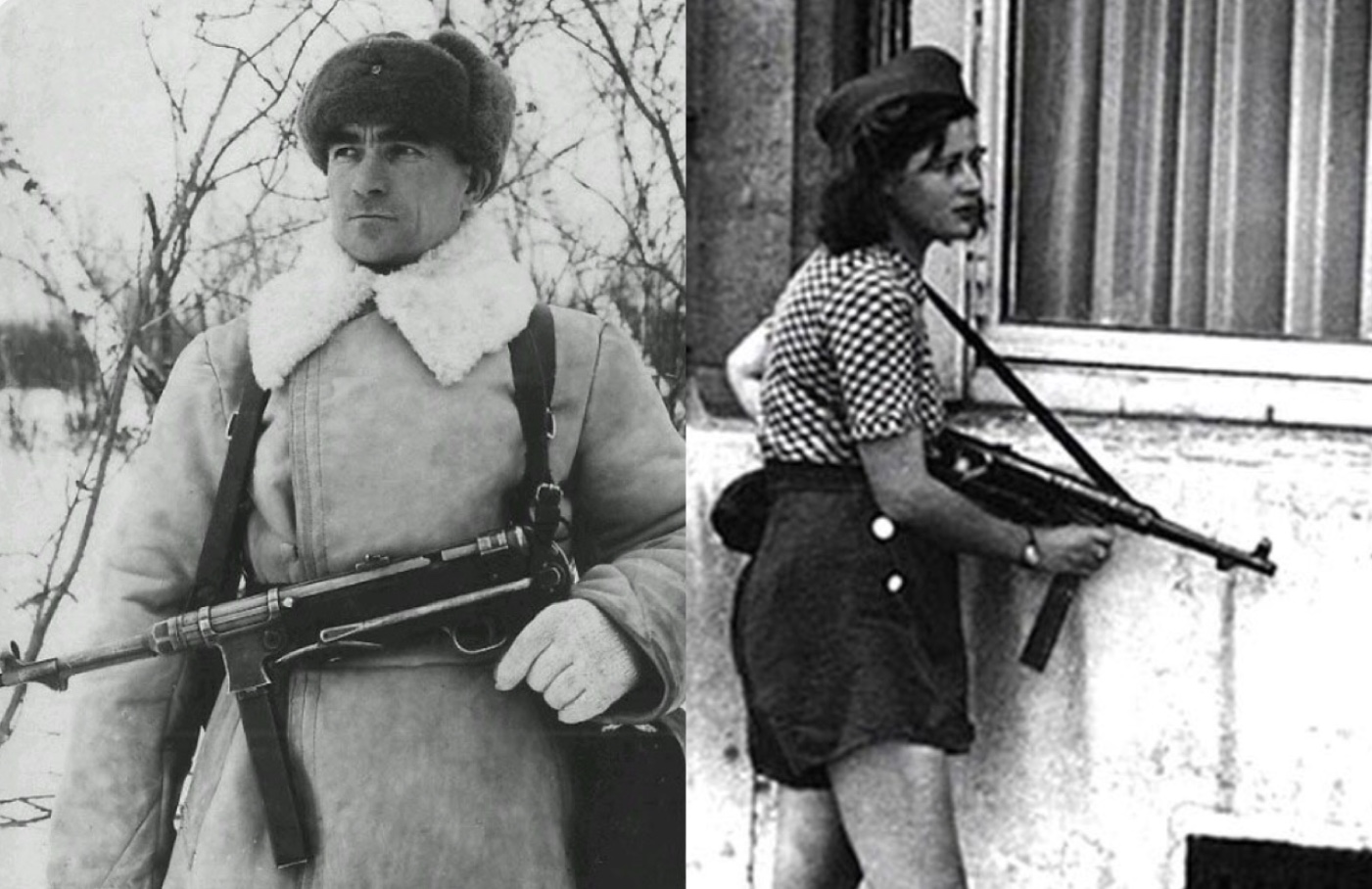
 Then this September, Kohfield appeared on the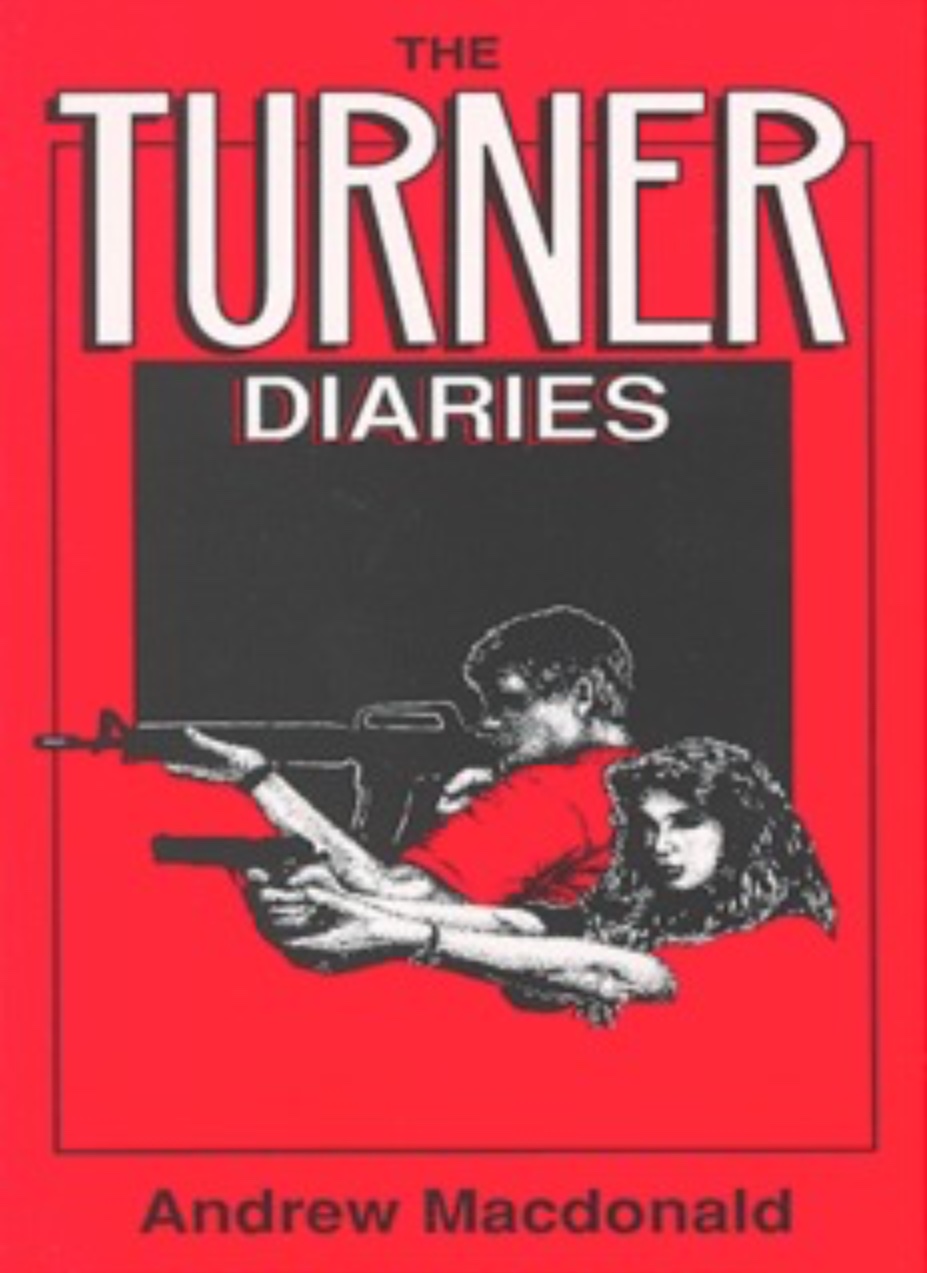

 Occupy the 2nd Amendment